






Smooth Moves: Are Bedroom Acrobatics Next for China’s Humanoid Robots?
Robot martial arts performance shows unprecedented physical agility and control

From Robbie the Robot lurching across alien terrain waving jerky arms to warn Will Robinson of impending danger, to videos teaching kids to dance like a toy robot, anyone who hasn’t been raised by wolves knows how robots are supposed to move: stilted, awkward, and clumsy. And though modern humanoid robots do a lot better through advanced engineering and artificial intelligence, they can still bump into mirrors, fall down, fail at breakdancing—and worse—even after countless hours of training and programming.
But a flawless performance of martial arts, featuring dozens of young Kung Fu and Wushu students sparring with dozens of nimble Unitree GE1 robots—wielding swords, poles, and nunchaku—has startled the world and demonstrated the dominance of China’s robotics industry. Suddenly moving like a robot looks more like a polished Cirque du Soleil performer!
The performance aired live during China Media Group (CMG’s) Spring Festival Gala, said to be the most televised event in the world, watched by billions. It sparked breathless commentary—and probably competitor envy—from around the world. Dr. Julia McCoy, founder of AI training company First Movers, used her own AI clone to describe “dozens of humanoid robots performing drunken fist martial arts, doing kung fu in perfect synchronization, executing 3-meter aerial backflips on live television, now fully autonomously, in front of 1 billion people.”
The gala also featured child-sized robots from another company in a comedy sketch, and also included a robot clone of the human grandmother character.
So what does this have to do with sex?
Use your imagination, but not for much longer

China is also home to innovations in sex dolls, featuring expressive movements in face, body, and artificial genitalia, naturalistic skin, heating, and AI capacities such as voice and chatbot conversation. Their mostly female appearances are designed to be ultra-glamorous, but the dolls as a whole do not yet move independently and autonomously. They can be posed but they do not wrap their arms around their owners, let alone hop out of bed to make coffee.
But since China’s mainstream humanoid robotics companies are designing for home and retail use, as well as industry and military—given the advancements just demonstrated by GE1—it is probably only a matter of time before the two industries join forces to create social robots, including the humanoid lovers of some people’s dreams. I’d be surprised if such products are not already on someone’s design table.
As M. Christian, our late managing editor, put it:
“Producing a robot capable of mimicking a human’s movements could still be a massive game-changer. Even if their robots can’t function independently—or at least not for an extended period—it’d be a very small price to pay to have a walking, sitting, dancing, and so on artificial companion—albeit one that requires an extension cord to do so.”
But turning an autonomous humanoid robot like the GE1 into a safe, pleasurable sex partner suitable for home use is going to take a completely different kind of specialized training, won’t it? And who’re you gonna call?
A team of sexologists and sex therapists, perhaps?
RECOMMENDED READ: Look Who’s Feeling: New Haptic Tech Plus Sexbots May Equal Endless Erotic Possibilities
Human level dexterity, and then some
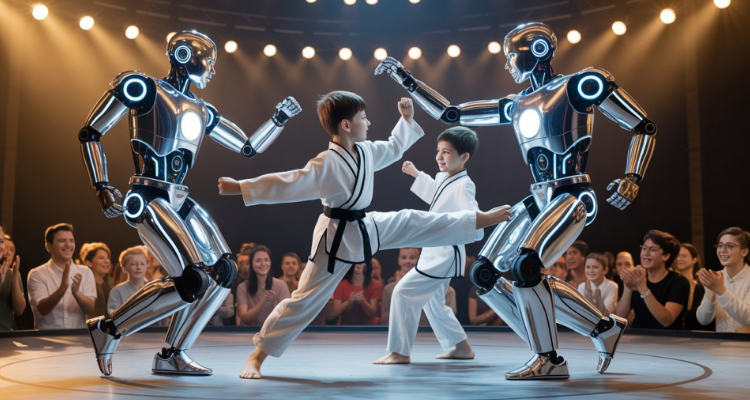
Let’s examine how some of the skills and movements demonstrated by China’s newest humanoid robots may be transferable or adaptable to sexual situations.
For example, Rebecca Chin, an accomplished Wushu competitor and choreographer, notes aspects of the performance that might elude those who don’t have her training, such as “in drunken style, you are intentionally putting yourself extremely off-balance and then just barely catching yourself.”
Julia McCoy was also impressed by the engineering required for the drunken fist sequence, made famous by martial arts star, Jackie Chan:
“And here’s the engineering detail that blew my mind most. The drunken fist sequence where robots wobble and stagger as part of the martial arts style required not just balance, but intentional controlled imbalance. That’s not a glitch, that’s a feature. The robots had to learn how to fall gracefully and recover fluidly, simulating a fighting style that’s built around the appearance of instability. That’s next level robotics.”
Bringing the next level into the bedroom

Think about it. Many sexual actions and positions can be awkward, off-balance, and require a certain amount of flexibility and ability to create movement work-arounds in real time. From a sexological perspective, these next level abilities—combined with the GE1’s autonomy and proprioceptive sensors—would be essential for an erotic robot in training.
Chin noticed something else:
“Something that I’ve come to appreciate is very difficult is the subtlety of waist movement in martial arts. The movement is so complicated in that it’s not just like you have your hips hinged forward and your legs move in a couple of directions. It’s really a coordination of your waist with your upper and lower body to get that smooth transition.”
Again, hip swiveling, pivoting, swaying side to side…very helpful for sex, even with an artificial partner. In the near future, robo-sex may no longer be limited to just the old in out-in out.
There’s more. How about the GE1’s dexterity, as demonstrated by its handling of martial arts implements? Manual dexterity will of course come in handy in other, more intimate situations.
Just…give it a face, already.
Eroticize, not weaponize

After witnessing the fighting skills and intelligence of the GE1 and Agibot products, many people are more worried than ever about robot warriors. I agree there is reason to be concerned about machines that can move seamlessly as a group while wielding lethal weapons and avoiding collisons with small children who shared the stage. I am sure the boys’ parents were white-knuckled through every rehearsal and performance!
Journalist Li Jingling’s compared the difference between this year’s polished performance with footage of Unitree’s 2025 human/robot choreography, which featured formations of GE1s waving handkerchiefs in that familiar stilted, robotic manner. You can watch most of the 2026 footage in her video, and see the difference in abilities for yourself.
Incidently, Unitree shipped about 13,000 GE1s in 2025, each costing about $13,500 USD. The 2026 models are certain to be even more popular.
Li says such rapid advances clearly shows China as “the world’s top level” in robotics. And Unitree is not the only top level robotics company in China, either. Four other companies, including AgiBot and Noetix, also showcased their robots in the 2026 gala, garnering public acclaim, funding, and government support.
In this, the Year of the Fire Horse, China’s robotics and AI industries have a lot to celebrate. Their achievements are rightfully a source of national pride. The only thing that might stand in the way of sex doll and robotics manufacturing collaborations in China could be a reluctance to tarnish the reputation of robotics industries should their technologies be incorporated into sex robots for home use.
I am not saying such an attitude exists, but it is possible. In any case, this is certain to be an interesting year for robots. Let’s see what happens!
IMAGE SOURCE: A.R. Marsh using Ideogram.ai