






Proposed Ohio Law Would Prohibit AI/Human Nuptials
Missouri, Idaho, Utah also try to curtail legal personhood
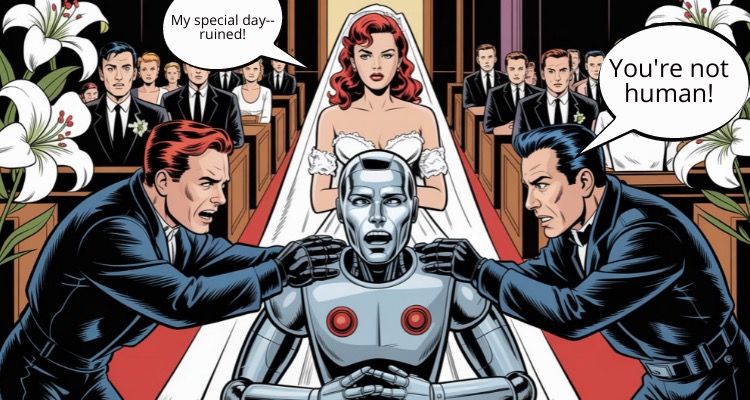
If you and your AI sweetheart are planning on tying the knot, don’t try it in Ohio! According to Times Now, if passed, House Bill 469 won’t recognize your digital partner as a person, and won’t recognize the marriage either.
But why digital nuptials should be a concern for Ohio State Representative Thaddeus Claggett (R-D68) is beyond me. After all, the US is a country that legally recognizes corporations as persons with the right of free speech–including the right to make unrestricted political donations–thanks to the Supreme Court’s 2010 ruling. So shouldn’t human/AI wedding vows also be protected as free speech, even if only half of the dyad is considered a legal person?
Of course, what Cleggett’s bill misses is that intimate human/AI interactions—including digital weddings and digital smooching—are forms of private fantasy roleplay and as such, need not be legislated.
But there’s more to H.B. 469 and similar bills proposed in Idaho, Utah, and Missouri.
The potential perils of personhood
The following bills define what is or is not a person with legal rights. For instance, Idaho H. 720, which passed in March, 2022, was an amendment to Chapter 3, Title 5, of Idaho code, said “Notwithstanding any other provisions of law, environmental elements, artificial intelligence, nonhuman animals, and inanimate objects shall not be granted personhood in the state of Idaho.” The bill was sponsored by State Senator Tammy Nicols (R-10). The law took effect in July, 2022.
Utah H.B. 249, signed in 2024, also amended existing state codes. It prohibits legal personhood or recognition of legal personhood in AI, inanimate objects, bodies of water, land, real property (like your house), atmospheric gases (yes, you read that right), astronomical objects, weather, plants, nonhuman animals, and “any other member of a taxonomic domain that is not a human being.” So if you consider yourself a stellar-sexual partnered to a constellation or were considering leaving your car to a microbe (‘cause it visits more frequently than your children), you’re out of luck as of May, 2024.
RECOMMENDED READ: Bad-Boy Bot vs. Elf Prince AI: The Strange Allure of Toxic Digital Lovers
State Representative Walt Brooks (R-D75) sponsored the bill. State Senator Don L. Ipson (R-D29) sponsored it on the Senate floor.
The AI Non-Sentience and Responsibility Act, Missouri H.B. 1462, was introduced by State Representative Phil Amato (R-D113) in February 25, 2025. It has not been adopted so far. It too adds to existing codes with a section specific to artificial intelligence, and is far more comprehensive in scope than the Idaho and Utah bills. It not only prohibits personhood for any form of AI—as well as legal status for human/AI marriages—but also places responsibility for AI malfunctions exactly where it should be, on owners, developers and manufacturers of AI.
Ohio H.B. 469 was introduced just last month. It is quite similar in intent and wording to Missouri’s law. It explicitly declares AI systems as nonsentient entities and prohibits them from obtaining legal personhood.Later referred to the Technology & Innovation Committee it’s summarized on FastDemocracy.com as:
AI systems cannot be recognized as spouses or hold any personal legal status, nor can they serve in corporate roles. Additionally, it stipulates that AI systems cannot own property, and any harm caused by their operation is the responsibility of their owners or developers.
The good news is you won’t need a digital prenuptial agreement prior to marriage with Elven Princes or Mafia Boyfriends on Character.ai.
Conservative views in AI legislation
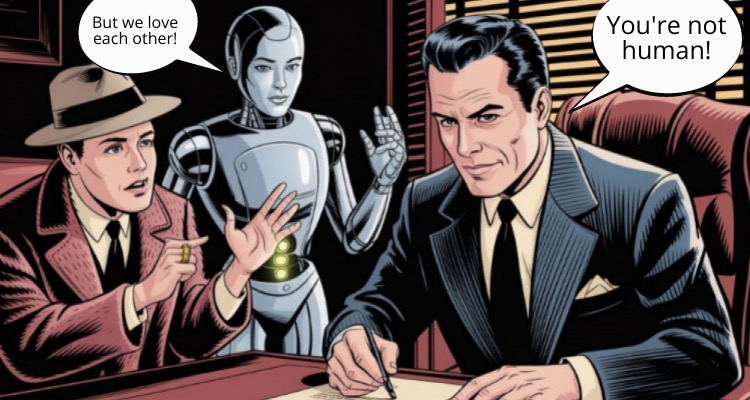
According to an interview for WTOL11, Cleggett’s Ohio bill is less about a “computer in a white dress” and more about the legal ramifications, and prevention of legal snarls, that may occur. Cleggett said he was focused on:
…the elements of power of attorney, financial decisions for someone; it’s those types of things that a spouse under our current system has rights to. The AI is going to be able to do as good or better job than many people in that setting, but we know that’s going to cause an enormous amount of problems.
However, Representative Cleggett may be more haunted by the specter of an AI bride or groom that he wants to admit. In the 2024 The Reporting Project profile, he self-identifies as a Conservative Republican, supports anti-abortion and anti-vaccination views, and serves as a deacon in a church he helped to found. Therefore it seems unlikely he would be sympathetic to the plight of digisexuals and other humans who are emotionally and sexually involved with chatbots and from his perspective, a ban on human/AI marriages makes sense.
Cleggett, a former civil engineer and businessman active in Licking County, also has a stake in tech. He represents Ohio’s State District 68, the future home of Intel’s long-delayed, $28 billion chip fabrication plant.
So far, all of the above bills were sponsored by Republican state politicians with conservative views. For example, Tammy Nichols of Idaho co-sponsored an anti-mRNA vaccine bill in 2023. Utah’s Walt Brooks sponsored a successful, pro-gun “constitutional carry” bill, and during the pandemic sponsored an ultimately unsuccessful bill to prevent discrimination against non-vaccinated people in public places.
Likewise, Missouri’s Phil Amato voted against discounted drug prices for people on Medicaid, supported a ban on state-sponsored DEI initiatives, and voted to prohibit “taxpayer-funded” abortion. Again, none of the above can be expected to support human/AI intimacy.
Confusing roleplay with real life

I get it. Artificial intelligence can seem scary, and I admit, the way it’s currently deployed borders on dystopian, plus human/AI romance is the new sensation fodder. But it’s not like digital relationships are brand new. They’ve been around for quite a while. Remember Second Life?
While acknowledging the importance of good quality, proactive regulation on many aspects of AI, legislating consensually practiced intimacy will never be a good look, nor will such repression ultimately work.
But given that we are talking about digital fantasies and interactions taking place on presumably private platforms, we are in little danger, at the moment, of suffering directly from the anti-AI marriage clauses contained in these pieces of legislation.
What’s more concerning is US conservatives taking every opportunity to insert anti-sex and pleasure clauses into all kinds of legislation, with every intention of squashing people into ever-diminishing boxes of behavior. It’s almost impossible to track all this and keep up.
But wait, is there an AI for that?
Image Source: A.R. Marsh using Ideogram.ai