






“State of the Vagina Report:” 98.6% of Us Women Cannot Correctly Identify Female Sexual Anatomy
Why a disposable speculum and a hand mirror may be the best sextech to own

It’s almost 2026. Ladies, do you know where your cervix is?
Apparently not. According to a new report based on a survey of 3,196 women, almost all participants could not correctly name all parts of their genital anatomy.
According to Personal Care Insights, this staggering statistic, and many others almost as startling, are the result of a survey conducted by the sexual wellness company, O Positiv Health, in a preview of their upcoming State of the Vagina Report.
The findings are based on a demographically representative sample of cisgender women who live in the US. The full report will be published in January 2026.
I say “vulva,” you say “vajayjay.”

It’s 1973. I was a teenage pregnancy counselor at the Beach Area Community Clinic in a coastal town in San Diego County, CA, and the proud owner of the first edition of Our Bodies, Ourselves: A Book By and For Women by the Boston Women’s Health Book Collective. According to Wikipedia, OBOS was revised and expanded six times, with the final edition published in 2011.
With this source of powerful knowledge at my adolescent fingertips, how could I have ever imagined that in the century to come, most people with female-gendered bodies would know even less than I did?
I don’t know what happened to my copy of this book, but these days Our Bodies, Growing Older: Women Aging with Knowledge and Power (1987) has a place of honor in my sexology bookshelves.
In those heady days of women’s health activism—and the clinic where I worked was also at the vanguard—one of my best adult friends, Marcia Kerwit (aka Marcia Wexler), was one of those standout pioneers who went around the country teaching groups of women to do their own gynecological self-exams with a speculum, a hand mirror, and some decent lighting.
Marcia asked me once, while we were talking and sipping tea at her house, if I’d like to learn how? I declined, though I’m not sure why. I certainly wasn’t squeamish—after all, part of my clinic job included making sure the stainless steel speculums were sterilized, along with performing pregnancy tests and delivering results and resource information to anxious patients.
Marcia would later collaborate on the phenomenal book, A New View of a Woman’s Body: A Fully Illustrated Guide, by the Federation of Feminist Women’s Health Centers (US), published in 1981. You can find an online copy at the Internet Archives. A free account will allow you to read it. Copies on eBay range from $30 to $100 USD.
Did I mention Marcia was and is a constant inspiration to me, even though she passed many years ago? Knowledge of friendship preserved.
Knowledge lost and found—and lost, and found again

A New View contains historically significant illustrations by Suzann Gage, RN, including the first contemporary drawings of all features of the internal clitoris. As there was a dearth of female anatomical information at the time, she researched and based her work largely on cadaver dissection drawings in medical textbooks from the late 1800s-early1900s.
But NIXIT’s timeline of “The Invisible Vulva” skips the discoveries of Gage and others in the feminist women’s health movement of the 1960s-1970s. History erased, knowledge lost.
Similarly Manther, an erotic literature publication, credits the feminist movement with sexual liberation and a focus of clitoral pleasure, its article credits Dr. Helen O’Connell, with “providing new insights into the anatomy of the clitoris” in 1998, ignoring Gage’s contributions seventeen years earlier.
Dr. O’Connell’s research included dissections on “2 fresh and 8 fixed human female adult cadavers (age range 22 to 88 years)” and concluded “current anatomical descriptions of female human urethral and genital anatomy are inaccurate”—the same discovery Gage made when researching the clitoris.
The future of sex relies on the past
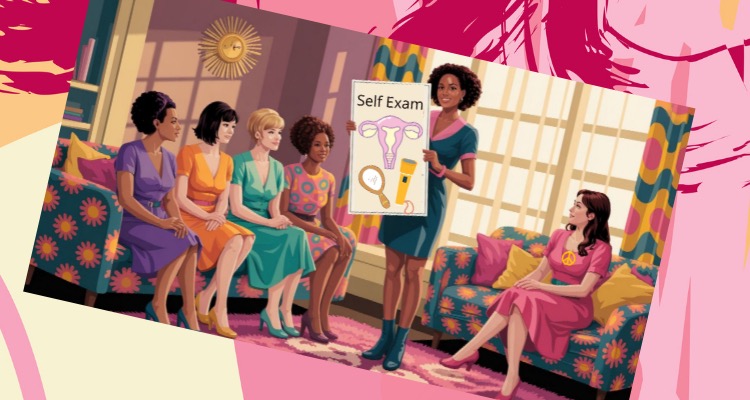
It’s almost 2026, but if most people with female reproductive systems can’t name all the features of their genitals and reproductive systems, let alone know the difference between vulva and vagina, how can they hope to understand the pleasure-packed erectile tissue of their entire clitoris? After all, most of that is hidden from sight, unless you’re dissecting a corpse.
But other features are easily discoverable. For example, the original instructions for pelvic self-exams–developed and taught by feminist health activists of the 1970s—can be found on the internet. Once you actually see your own cervix and vaginal walls, it can be as transformative as it was for Suzann Gage, the activist artist inspired to become a specialist in women’s health.
Last summer the New York Post interviewed a doctor who says this self-care can enable a person’s knowledge of their anatomy, what’s normal for their body, and to spot potentially troublesome changes early. Some medical sites also speak of the benefits and provide instructions, but in real life, I’ve yet to have a gynecologist actually recommend this kind of self-care to me, as is probably the case for most patients.
So while speculums, flashlights, and mirrors hardly count as glamorous sex tech, these humble items have a definite place in our sex lives. You might even add them to your toy box, and let your vibrator remind you to grab the speculum and take a peek now and then.
The future of sex relies on better sex education, for everyone

The findings of the O Positiv Health survey, and similar research before it, reveal a glaring deficit in basic sex education for cisgender women. This is truly mind-boggling, given decades of grassroots activism given above, but also the abundance of newer books empowering female sexuality, such as The Clitoral Truth by Rebecca Chalker and Shari Winston’s Women’s Anatomy of Arousal: Secret Maps to Buried Pleasure, both of which I highly recommend.
Over the years, sex educators have also created clever teaching tools to help people visualize female sexual organs, including the well-known Wondrous Vulva Puppet created by Dorrie Lane in 1992, made of velvet, satin, and other luxurious fabrics. This video shows how one of Lane’s vulva puppets can be used in a class about vaginal dryness.
Recently the Bulbo Project uses AI-enhanced images to “help make female anatomy facts more visible and understandable,” particularly the clitoris, “an organ often absent from anatomy textbooks and cultural imagery.” Check out their amazing video.
Though AI can be used to create sex education materials, there may be a danger from AI slop, which can bury accurate information. Perhaps our collective sexual future will once again rely mostly on human to human transmission, like the feminist self-exam groups of the last century.
And just in case you want to know, according to the O Positiv report preview, the correct answer to their anatomy question is “vagina, ovaries, uterus, clitoris, fallopian tube(s), labia minora, labia majora, cervix, hymen, mon pubis.” 1.37% of respondents got that right, but let’s not forget to name the vulva, urethra, and perineum too. A vulva puppet could help.
Image sources: A.R. Marsh using Ideogram.ai; Women’s Clinic Class Brochure, A.R. Marsh c. 1972; Bulbo Clitoris and Bulbo Jacket, Kandela 3000, Oct. 28, 2025, public domain